
The Yin-Yang symbol is also called the Tai Chi Symbol because of its many practical interpretations for the art.
Seeing how the contrasting shades of black and white are interconnected in the symbol, for example, helps Tai Chi practitioners visualize and apply other contrasting ideas such as tension and relaxation, movement and stillness.
Not only the contrasting graphics, but also in form and line. The circular shapes and S dividing line in the symbol represent the movement patterns in Tai Chi, as well as the theoretical ideal of balance within continuous change.
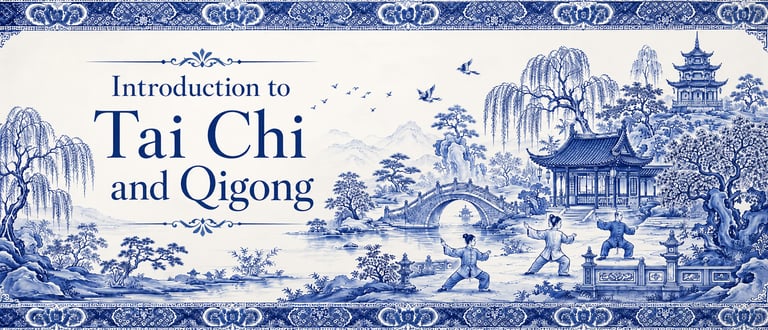

Tai Chi Chuan is an ancient Chinese martial art in which the training combines slow, flowing movements, mindful breathing, and focused awareness. These days Tai Chi is mostly practiced to promote health, relaxation, and overall well-being.
Tai Chi Chuan is usually translated as “Supreme Ultimate Boxing”:
Tai (太) – supreme, great, or grand
Chi (极 / 極) – ultimate, highest point, or polarity
Chuan (拳) – fist, boxing, or martial art
Consistent practice of Tai Chi improves both physical and mental health. Its graceful, continuous movements encourage the body to move with balance and coordination, while calming and clearing the mind.
Qigong (pronounced Chee-Gong) is not a martial art, but a system of gentle exercises, breathwork, and meditation that has records stretching back to nearly 200 years BC.
Qi (氣 / 气) – life force, or the body's vital energy
Gong (功) – skill or art developed through consistent effort
Qigong principles are the foundation of many traditional Chinese health practices, including martial arts. There are many forms of Qigong all developed to cultivate health, vitality, and mental calm, and are often used in Tai Chi class as supplementary exercises.


flowfitness © 2026
flowfitness: developing strength, mobility and balance at any time of life
Join the Mailing List for updates:
We care about your data in our privacy policy.